
The best road trips in Europe in a campervan will provide breathtaking views and a chance to soak up the culture of the area you’re travelling in.
After all, one of the big perks of owning one of the best campervans is the freedom to set off on an adventure whenever you like. Just like the best UK road trips, European routes can vary in length, from Romantic Road Germany (which takes three to seven days) to the Wild Atlantic Way in Ireland (which is more like two to three weeks).
Travelling to Europe can provide stunning scenery, picturesque villages and fascinating history – you’ll just need to decide between the ferry or Eurotunnel!
If you’re after some ideas for your next European tour, we’re sharing six of the best campervan road trips in Europe.
The best road trips in Europe in a campervan
Romantic Road Germany
Wild Atlantic Way Ireland
West Coast Route Norway
Zagreb to Dubrovnik Croatia
Braga to Faro Portugal
Historic Normandy France
The best European campervan road trips
Romantic Road Germany
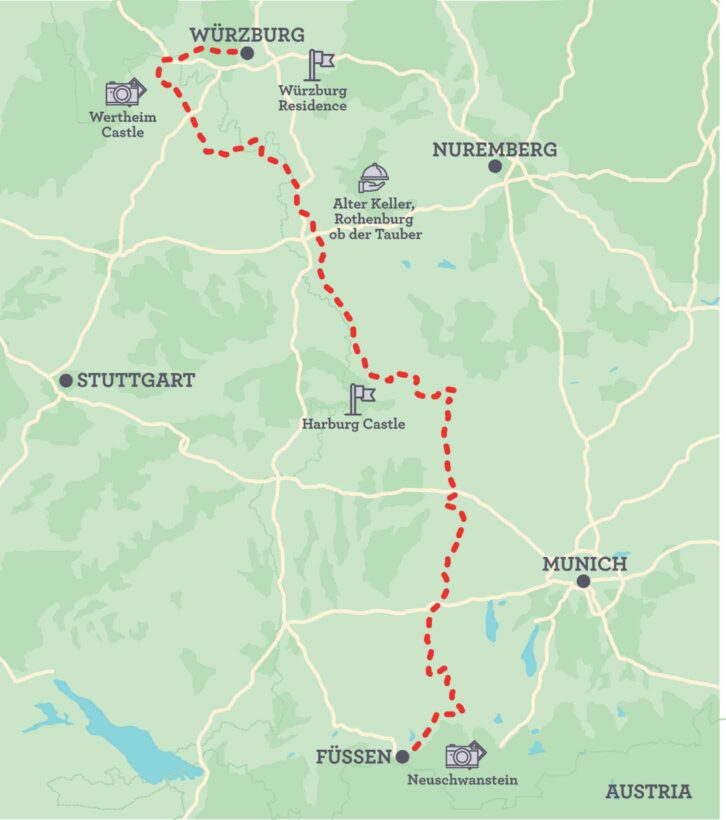
- Distance: 280 miles
- Time: Three to seven days
- Start: Würzburg
- Finish: Füssen
- When to travel: July to October for better overall weather conditions
Start/finish campsites
You don’t need to be a genius to work out what draws people to Germany’s Romantic Road – its sense of romance.
Starting in the northern regions of Bavaria and Baden-Württemberg, the route takes in picturesque villages, historic medieval towns, beautiful vineyards, and stunning palaces and castles, and ends dramatically at the foot of the Alps in southern Bavaria.
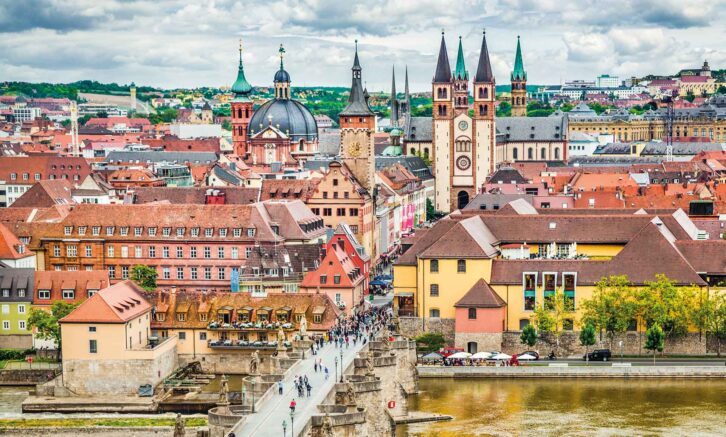
Your journey begins in the city of Würzburg. You’ll be keen to hit the road, but be sure not to neglect a place that’s worthy of exploration in itself. The most famous attraction is the 18th-century Würzburg Residence, a UNESCO World Heritage Site thanks to its Baroque and Neoclassical architecture, ceiling frescoes by Giovanni Battista Tiepolo, and grand halls.
From Würzburg, you’ll be driving through the Tauber Valley, a wine-making region that’s going to treat you to fine views of vineyard-covered hills, with old castles dotted among them along the route.
Next is one of the trip’s many highlights: Rothenburg ob der Tauber. Rothenburg is a stunning medieval town that’s famous for its cobbled streets, medieval walls and traditional German architecture.
Your next major stop will be Augsburg, then you’ll head through the towns of Friedberg, Kaufering, Landsberg am Lech, Hohenfurch and Schongau. These stops are of course optional, although we’d pick out Landsberg and Schongau as two to consider.
From here, the character of the Romantic Road begins to change as the Alps start to become visible on the horizon.
There are some beautiful and historically significant religious buildings to take in on this leg of the journey, including Rottenbuch Abbey, Steingaden Abbey and Wieskirche, the latter a site of pilgrimage since its founding in the mid-1700s. However, you could be forgiven for powering through to one of Germany’s most iconic sights.
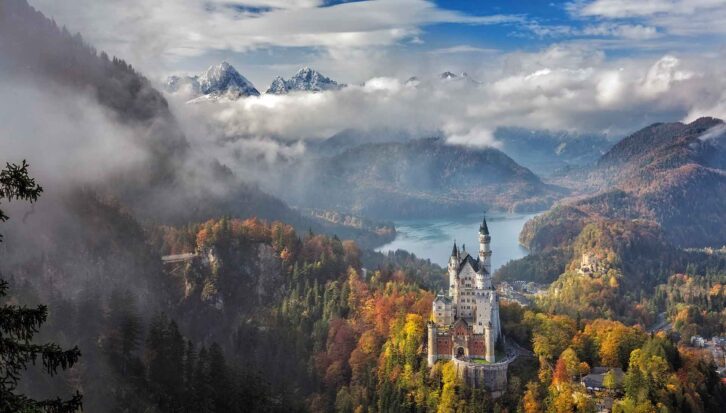
Weaving your way through charming villages with the Alps soaring into view, you’ll soon reach the inspiration for the famous Disney Castle, the fairytale palace that is Neuschwanstein Castle.
Top tip: Consider a December trip to take in the traditional Christmas markets – just make sure you know how to keep a camper van warm in winter first!
Wild Atlantic Way, Ireland
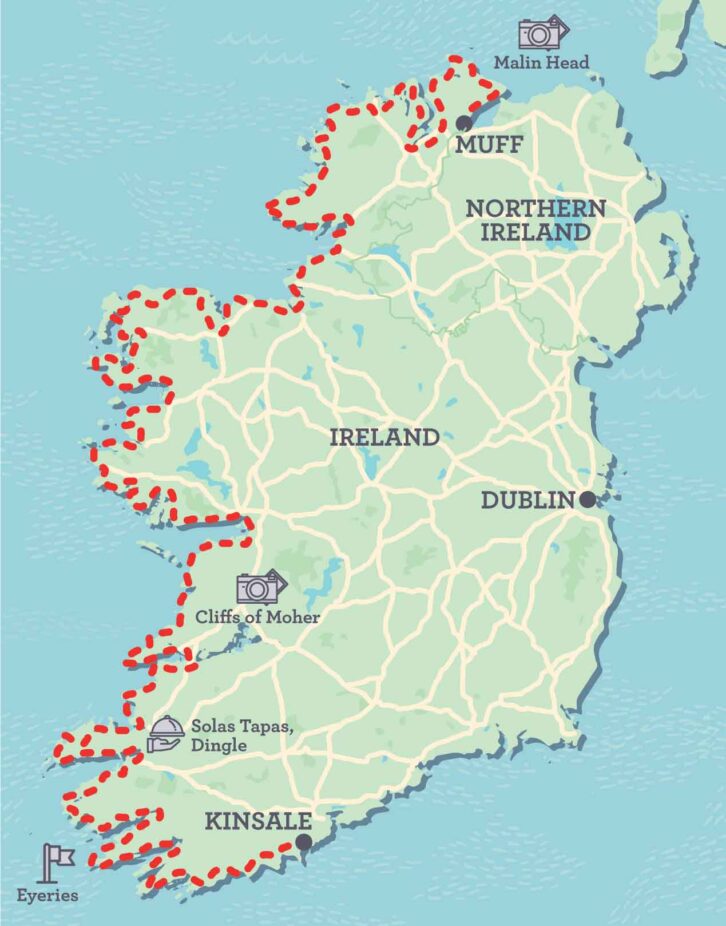
- Distance: 1550 miles
- Time: Two to three weeks
- Start: Kinsale
- Finish: Muff
- When to travel: April or October, when the roads are quieter and campsites cheaper!
Start/finish campsites:
If Jack Kerouac’s iconic novel On The Road had been set in Ireland, the Wild Atlantic Way is the road they’d have taken.
Weaving around the west coast, it clings to the outermost peninsulas, running the length of Ireland from Kinsale in the south to Muff in the north.
Just south-west of Cork, in the pretty town of Kinsale, is the starting point for this 1550-mile journey to the Inishowen Peninsula in County Donegal.
Following brown road signs adorned with a white wave – the official symbol of the Wild Atlantic Way – travellers head north, meandering along the coast.
Passing Mizen Head and Dursey Island, you zig-zag through Kenmare, a small town with a thriving music scene, where the main draw is the unmissable bay.
Leaving Kenmare, the Wild Atlantic Way joins the Ring of Kerry, one the most famous scenic drives in Ireland. The cliffs here are taller, the water a deeper blue and the mountains simply sky-piercing.
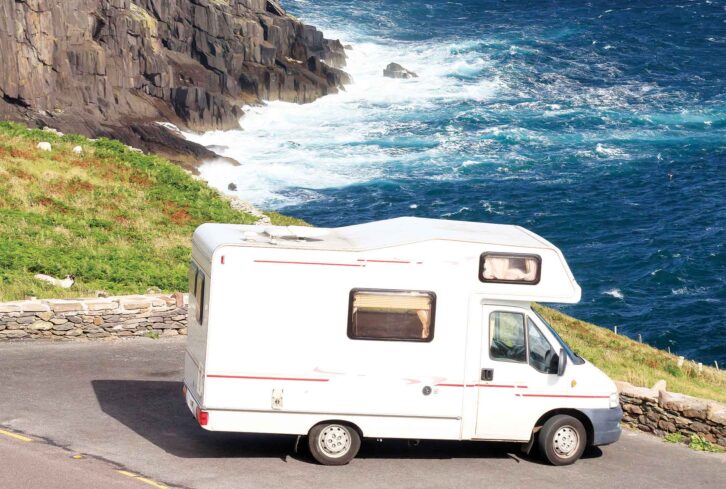
The journey continues west out of Dingle, along the sheer cliffs of Slea Head Drive, passing picturesque Dunquin Harbour.
Beyond Killimer, the Cliffs of Moher dominate the skyline. Over 350 million years old, they stretch 8km (five miles) along County Clare’s awe-inspiring coast, rising a dizzying 210m (68ft) above the ferocious Atlantic Ocean.
After the cliffs, the traditional village of Doolin calls. Just 5km (three miles) north, this makes an idyllic pitstop, with a handful of traditional pubs, complete with roaring fires, serving steaming bowls of Irish stew and creamy pints of porter.
Then, after Galway, the Wild Atlantic Way cuts through wind-carved Connemara to Clifden, offering up magical panoramas of the ocean. Passing through the coastal town of Westport, the road continues north to the mesmerising sights of Sligo.
After the dramatic landscapes of Malin Head, the road rolls on to the village of Muff, on the border of Northern Ireland, and the end of the Wild Atlantic Way.
Top tip: The roads can be tricky and tight in places, so take your time on this route
West Coast Route, Norway
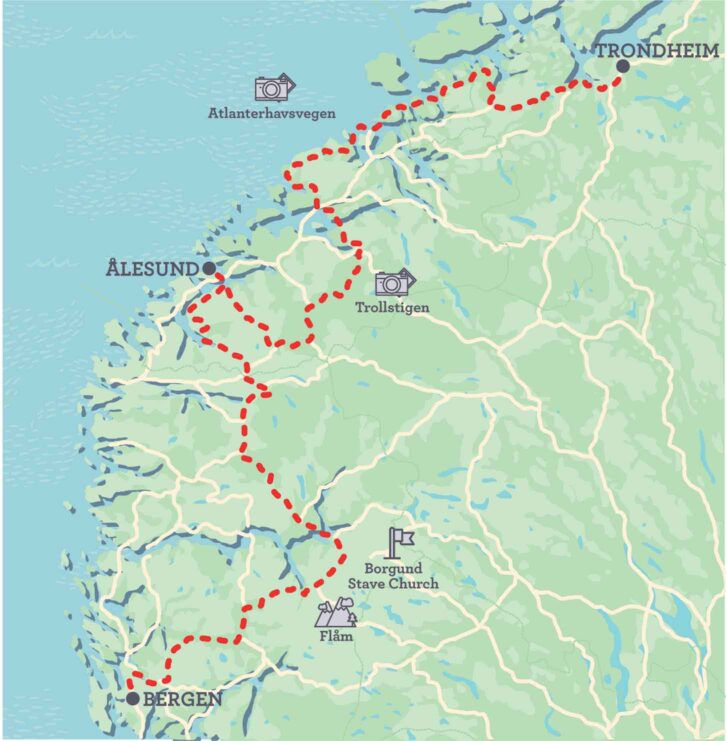
- Distance: 683 miles
- Time: Seven to 10 days
- Start: Bergen
- Finish: Trondheim
- When to travel: May to June and September to October (great weather and not so busy)
Start/finish campsites
Norway is renowned for its natural beauty, whether it’s the lush forests and national parks, the intense peaks that adorn every vista or, of course, the deep blue fjords that the country is famous for.
That’s what makes the West Coast Route of the Norwegian coastline so compelling.
The route kicks off in Bergen, which is itself worth setting aside some time to explore. It’s a picturesque wharf town, small enough and laid out in such a way to be completely walkable.
From there you’ll head north towards Ålesund – manageable in a day if you set off early, but with plenty to see along the way if you prefer to make a few stops.
There are a couple of choices in driving this route, the first being to take the E39 all the way to Førde, stopping for a bite to eat at one of the charming villages you’ll see.
This way, you’ll also pass alongside Lake Jølstravatn – a tremendous display that is definitely worth a stop – and it is overall a quicker route north.
Alternatively, you could head along the E16, through the forested hills of southern Norway via the idyllic village of Flåm beside the Aurlandsfjord, an offshoot of Norway’s longest and deepest fjord, Sognefjord.
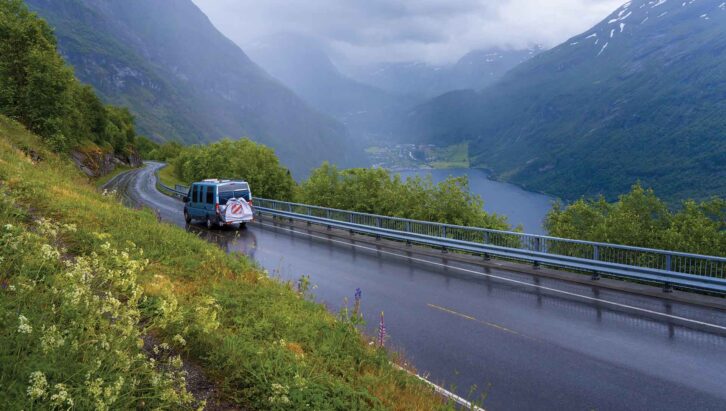
North from Geiranger you’ll be aiming for two key points: Ørnesvingen (the Eagle’s Road) and Trollstigen (the Path of Trolls). These winding mountain roads are an iconic part of road-tripping in Norway, and you won’t want to miss the viewing platforms that stand at the summit of each.
Before reaching Trondheim, there’s one final part of the journey that you’ll want to fit in. After heading north towards Molde, follow the coastal route until you reach Bud. As a tiny fishing village overlooking the Atlantic – now a very popular tourist destination – Bud is precisely the sort of place that you would expect to see on a postcard of Norway.
After passing through the pleasant coastal town of Kristiansund, the route is drawing towards its end. The long history of Trondheim makes this the perfect final destination, although in truth there is so much more of Norway available to see.
Top tip: The fjellinjen.no website will help you plan your route according to potential toll fees, which is a must in a country as expensive as Norway
Zagreb to Dubrovnik, Croatia
Croatia is a beautiful country and this road trip will show you exactly why. The route starts in the vibrant city of Zagreb, offering everything from cobblestone streets to contemporary art. Driving out from here, you’ll move into the stunning Plitvice Lakes National Park. Among these rich forests, you’ll find beautiful rivers, lakes and waterfalls.
Next, you should stop in Šibenik to explore the beautiful medieval old town, then Split, for its famous Roman monuments.

The ancient walled city of Dubrovnik is a spectacular finale to your journey. This truly awe-inspiring place, set above the azure seas of the Adriatic, boasts beautiful architecture that makes it a delight to wander through.
Braga to Faro, Portugal
From your starting point in Braga, you’ll be heading straight to a UNESCO World Heritage Site in the form of the medieval town of Guimarães, where you’ll find beautiful churches, castles and palaces, as well as a charming town centre.
It’s a short hop to Portugal’s second largest city, Porto, a fabulous destination on the banks of the Douro.
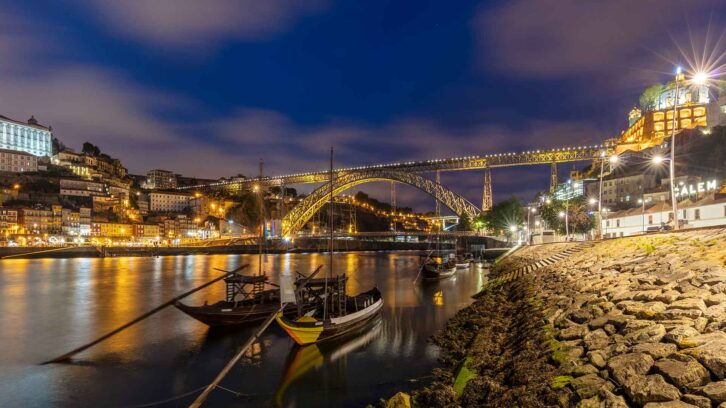
From here, you’ll travel through the vineyards of Penafiel, before hitting the beaches of Ericeira on your way to Lisbon, Portugal’s energetic capital.
Next, you’ll be treated to the coastline of the Algarve on the way to your final stop, and one of the jewels of this scenic region, the historic city of Faro.
Historic Normandy, France
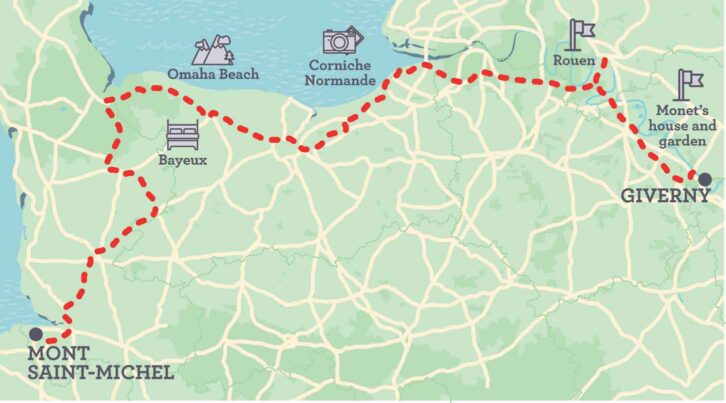
- Distance: 273 miles
- Time: One week
- Start: Giverny
- Finish: Mont Saint-Michel
- When to travel: Spring and summer for warmer weather, although the tourist hotspots will be busier
Few places in the world combine medieval and modern history quite so seamlessly as Normandy, in northern France.
Here, the iconic World War II cemeteries and memorials lie, serenely harmonious, in the shadow of magnificent Norman cathedrals, a stone’s throw from the lush countryside the region is famous for.
If you’re driving from Paris, your first stop on this journey should be the town of Giverny, on the border of Normandy. This picturesque place was home to Claude Monet, arguably France’s greatest artist, and his legacy lives on.
From Giverny, head towards Rouen. This remarkable medieval city is home to an 11th-century cathedral, featuring many noteworthy quirks from a millennium of reconstruction and renovations.
Caen is the next port of call for any tour of Normandy. Records of the town date back to the Romans, but little remains of its ancient past, as it was almost flattened by bombs during World War II. To learn more about Normandy’s role in the war, head over to the Mémorial de Caen.
Then it’s time to drive further along the coast, to explore historic Bayeux – this largely medieval city is the nerve centre of the region’s D-Day story, so it’s worth setting up base here for a few days.
A great place to start any tour of the area is the battlefield itself. There are five beaches to visit: Utah, Omaha, Gold, Juno and Sword. There are also several towns with remarkable tales of D-Day heroism.
Head to Sainte-Mère-Église to see the famous memorial to John Steele, the US paratrooper whose chute was entangled in the church’s spire.
Arromanches-les-Bains is another town worth seeing. Here, the Allied troops built a temporary Mulberry harbour, which played a key part in the invasion.
For a personal perspective, visit the war cemeteries. One of the most moving is the American Cemetery at Colleville-sur-Mer, with its large memorial and panoramic views of the historic beaches.
No trip to Bayeux would be complete without visiting the world-famous tapestry. Just around the corner looms the incredible Norman cathedral, which was remarkably untouched by the dramatic events of 1944.
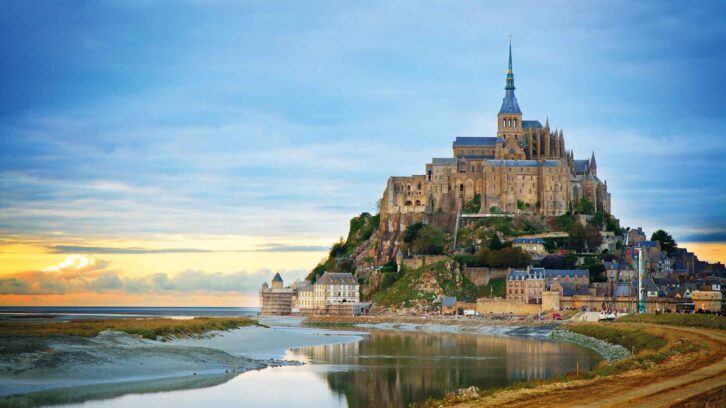
It would be possible to end your tour here in Bayeux – after all, we’ve barely scratched the surface of D-Day sites to visit. However, to do so would be to miss one of Normandy’s most exceptional destinations – Mont Saint-Michel.
For those of you who are considering a tour here, check out our guide to the best campervan sites in France to help you get the most from visits to this beautiful country.
Top tip: Visitors tend to flock to Bayeux in June, in the weeks surrounding the D-Day anniversary. Bear this in mind and plan your visit accordingly
After some more inspiration for where to go for a longer campervan getaway? Then head to our Go Campervanning: Longer Getaways section for more great ideas!
Lead image: Diego Delso CC BY-SA delso.photo
If you’ve enjoyed reading this article, why not get the latest news, reviews and features delivered direct to your door or inbox every month. Take advantage of our brilliant Practical Motorhome magazine SUBSCRIBERS’ OFFER and SIGN UP TO OUR NEWSLETTER for regular weekly updates on all things motorhome related.